May 8, 2026
Student
How to Get a 1600 on the SAT: A Realistic Step-by-Step Guide

A perfect 1600 is rare — fewer than 1% of test-takers achieve it. But "rare" doesn't mean "impossible." With a structured approach, honest self-assessment, and the right practice tools, it's within reach for students who are willing to work deliberately.
This guide breaks down exactly what it takes, section by section.
Step 1: Know Your Starting Point
Before you can plan a route, you need to know where you are. Take a full-length, timed practice test under real conditions — no pauses, no phone. The College Board offers free official digital SAT practice tests through Bluebook.
Once you have your baseline score, calculate the gap:
1400 → 1600: Significant but achievable in 3–6 months
1500 → 1600: A focused push on specific weak spots, usually 2–3 months
1550 → 1600: Precision work — you're fixing specific error patterns, not broad skill gaps
The higher your starting score, the more targeted your prep needs to be. Generic practice won't move the needle at 1550.
Step 2: Understand What the Digital SAT Actually Tests
The digital SAT has two sections:
Reading and Writing (800 points)
54 questions across two adaptive modules
Tests grammar conventions, vocabulary in context, main idea, evidence, inference, and text structure
Each passage is short — one paragraph — so context clues are limited
Math (800 points)
44 questions across two adaptive modules
Roughly 75% algebra and advanced math, 25% geometry, statistics, and data analysis
Calculator allowed for all questions
The test is adaptive — if you perform well on Module 1, Module 2 gets harder. Getting into the hard module is actually what you want, because the hard module is where the high scores live.
Step 3: Build a Targeted Study Plan
A generic "do 20 questions a day" plan won't get you to 1600. You need to identify the specific question types you're missing and drill those.
Monday/Wednesday/Friday: Timed practice sets (15–20 questions) in your weakest topic area
Tuesday/Thursday: Error review — for every wrong answer, write out why you got it wrong and the correct reasoning
Weekend: One full section timed (Reading & Writing or Math) + error log review
Adaptive platforms like Hueprep automatically surface the question types you're missing most, so you're not wasting time on things you already know. At the 1500+ level, that kind of precision matters.
Step 4: Master the Reading and Writing Section
Grammar and Conventions
The most predictable questions on the test. The SAT tests the same grammar rules repeatedly: punctuation, subject-verb agreement, transitions, pronoun-antecedent agreement, modifiers, and parallel structure. Learn the rules, then drill until your answers are instinctive.
Reading Comprehension
Every reading question has one correct answer directly supported by the text. At the 1600 level, stay inside the passage — your outside knowledge and intuitions are traps. For evidence questions, find the exact sentence. For words in context, define the word before looking at options.
Step 5: Master the Math Section
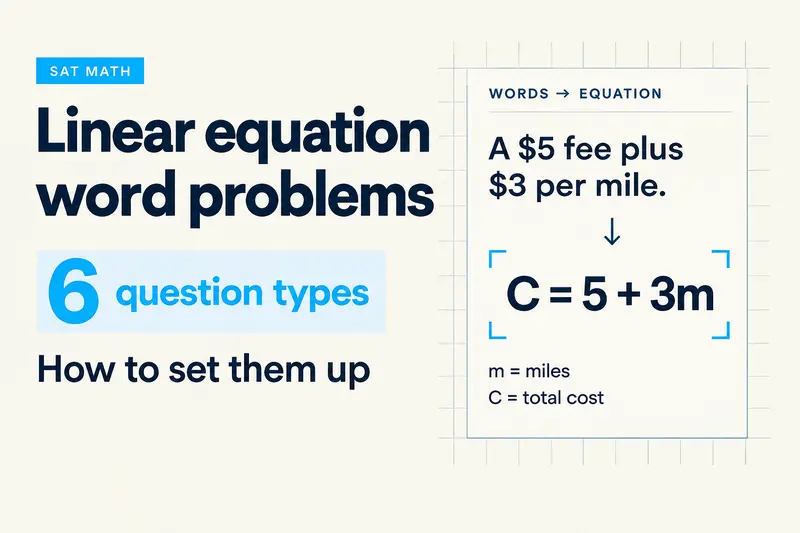
Algebra dominates the digital SAT Math — linear equations, systems, and quadratics make up roughly 35% of the section. Get these perfect first, then work through functions, percentages, statistics, geometry, and trigonometry.
Common 1600-Level Traps
Reading the wrong part of the graph: Slow down and re-read what's being asked.
Forgetting to check constraints: Inequalities and word problems often have constraints buried in the setup.
Rushing on easy questions: A careless error on a medium question costs the same as a wrong answer on a hard one.
Step 6: Simulate Real Test Conditions
In the final 4 weeks before your test, take at least 2 full-length timed practice tests using the official Bluebook app. Review every wrong answer in detail and practice the exact timing: 32 minutes for each R&W module, 35 minutes for each Math module.
Step 7: Take Care of the Non-Study Variables
Sleep: 8+ hours the night before.
Eat breakfast: Your brain runs on glucose.
Arrive early: Rushing raises cortisol, which hurts working memory.
Don't review the night before: The night before is for rest, not cramming.
The Honest Truth About 1600
A perfect score requires near-perfect execution. Most students who reach 1600 took the test 2–3 times. The students who get there aren't always the "smartest" — they're the most deliberate. They practice what they're bad at, review every mistake, and don't let a bad session derail them.
Ready to find out where your score gaps are? Hueprep's adaptive diagnostic identifies your exact weak spots across all SAT topics in under 20 minutes.
Blog
Recent Articles
AI automation insights to help your business move faster and smarter.