Nov 3, 2026
Did You Get the Hard Module 2 on the Digital SAT? What You Can Actually Tell

Quick answer: The test doesn't tell you which second module you got, so you can't know for certain. What you can know is how it works: every student sees the same first module in each section, and your performance on it decides whether the second module is easier or harder. A harder Module 2 usually means Module 1 went well, but how a module felt is an unreliable signal. The one thing in your control is accuracy on Module 1.
Right after a test, a lot of students search the same question: "Module 2 felt really hard. Is that good or bad?" It's a fair thing to wonder about, and it's one of the least understood parts of the digital SAT. This guide covers what's actually known, what's guesswork, and how to prepare for it. If you want the wider picture of how to raise your score, start with our guide to improving your SAT score. This post is only about the adaptive structure.
On this page
How Module 2 gets chosen
Can you tell which Module 2 you got?
Does an easier Module 2 cap your score?
What to do in Module 1
What to do when Module 2 feels hard
How to practice for an adaptive test
FAQ
Section | Questions per module | Time per module | Scored questions per module |
|---|---|---|---|
Reading and Writing | 27 | 32 minutes | 25 |
Math | 22 | 35 minutes | 20 |
Each module includes 2 unscored pre-test questions. Reading and Writing and Math are routed separately, so you can get a harder Module 2 in one section and an easier one in the other.
1. How Module 2 gets chosen
Each section of the digital SAT, Reading and Writing and Math, has two modules. The first covers a broad mix of difficulty levels. According to the College Board, the questions you get in the second module depend on how you performed on the first. Do well and you're routed to a harder second module; do less well and you get an easier one.
Each section is routed on its own. Doing well in Math Module 1 says nothing about which Reading and Writing Module 2 you'll see.
2. Can you tell which Module 2 you got?
Not reliably. The test doesn't label the second module, and the usual ways students try to work it out are weak evidence:
What you noticed | What it might mean | Why it's unreliable |
|---|---|---|
Module 2 felt much harder than Module 1 | You may have been routed to the harder version | Fatigue, a topic you find hard, or a run of tricky questions can feel identical |
Module 2 felt easier | You may have been routed to the easier version | It could also just be your strongest topics showing up |
One question looked completely unfamiliar | It might be a hard question | Each module includes 2 unscored pre-test questions, so it may not count at all |
The pre-test point is worth remembering. Because unscored questions are mixed in without being flagged, one strange question is not a sign you're doing badly, and it may not affect your score.
3. Does an easier Module 2 cap your score?
This is where a lot of online advice gets overconfident. The College Board does not publish the exact scoring rules or any cut-offs. Many test-prep sources report that the easier path limits how high your score can go, and that reaching the top of the scale generally requires the harder Module 2. That matches how adaptive tests work in general, because easier questions give less information about high performers.
But the specific numbers you'll see quoted online (exact ceilings, score floors) come from outside analyses, not from the College Board, so treat them as estimates. The practical takeaway doesn't depend on the exact numbers: Module 1 accuracy matters more than most students realize, because it decides which questions you get next.
4. What to do in Module 1
Module 1 is where careless errors cost the most, because they don't just lose one point; they can change what you see next. A few habits help:
Prioritize accuracy over speed. Rushing the first few questions to bank time is a poor trade. Those questions are usually the easier ones, and they're the ones you can't afford to miss.
Read the question stem twice before you answer. Misreading what's being asked is the most common avoidable error. We cover this in detail in our post on going from 1100 to 1300.
Flag and move on from genuine time sinks. One stubborn question shouldn't cost you three easier ones. Use the in-app flag, answer your best guess, and come back if time allows.
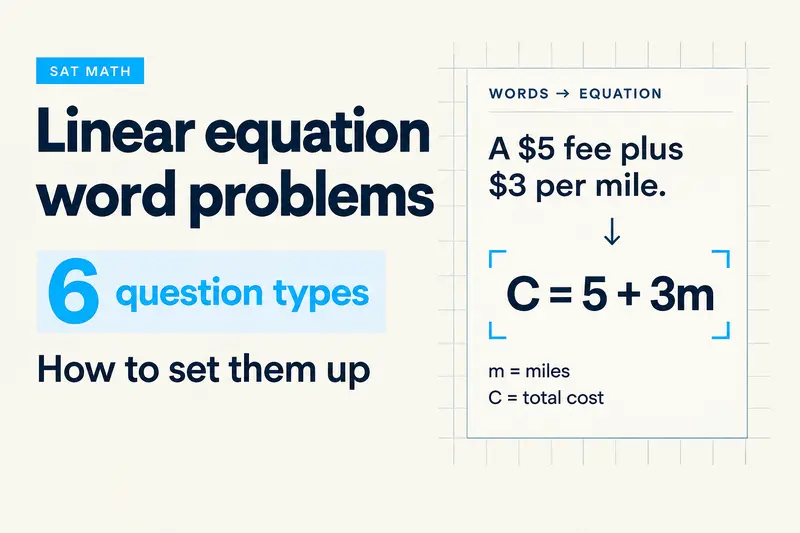
Check units, signs and what the question is solving for. On word problems especially, the set-up is where points leak. Our guide to SAT linear equation word problems shows the six set-ups worth recognizing.
5. What to do when Module 2 feels hard
If the second module feels harder, it's often a sign that you did well on the first. Stay with it:
Answer every question. There's no penalty for wrong answers on the digital SAT, so never leave one blank.
Don't let one hard question drag you down. Guess, flag it and move on. The harder module is built to have questions most students will miss.
Don't read the difficulty as a verdict. Feeling stuck is normal on a harder module and says little about your final score.
If Module 2 feels easy, don't assume the worst or relax. Keep checking your work, since careless errors cost just as much there.
6. How to practice for an adaptive test
You can't train for the adaptive structure by working through random question sets. You need to practice in the same format:
Take full adaptive practice tests. Practice that mirrors the real routing, where Module 1 decides Module 2, shows you how you perform when the stakes of each module are real. Hue Prep's practice tests replicate the adaptive structure of the real digital SAT.
Review Module 1 mistakes first. Sort them into content gaps, careless errors and timing errors. Careless errors in Module 1 are the cheapest points to win back.
Practice your weak topics in short, targeted sets. Once you know which question types you keep missing, drill those specifically instead of re-reading everything. Our SAT algebra practice questions are a good place to start for Math.
Use the official app. The College Board's Bluebook app is what you'll take the test in, so get comfortable with its tools and flagging before test day.
Studying for the SAT? Try Hue Prep: adaptive-style practice tests, plus targeted practice on the question types you're actually missing.
FAQ
Does the digital SAT tell you if you got the harder Module 2?
No. The test doesn't label the second module, so students can only guess from how the questions felt, and that's an unreliable signal.
Is a harder Module 2 a good sign?
Usually, yes. Because Module 1 performance decides routing, a harder Module 2 generally means Module 1 went well. But how a module feels is not a reliable measure, so it isn't a guarantee.
Can one hard question mean I'm doing badly?
No. Each module includes 2 unscored pre-test questions that look like any other question, so a strange or very hard question may not count toward your score.
Are Reading and Writing and Math routed together?
No. Each section has its own Module 1 and Module 2, and routing is decided separately for each, so you can get a harder second module in one section and an easier one in the other.
Does an easier Module 2 limit my score?
Many prep sources report that it limits the top of the score range, but the College Board doesn't publish the exact scoring rules. The reliable advice is to maximize accuracy on Module 1.
Should I guess if I don't know an answer?
Yes. There's no penalty for wrong answers on the digital SAT, so answer every question.
Sources
College Board, What is Digital SAT Adaptive Testing?: official explanation of how Module 1 performance determines Module 2.
College Board, Digital SAT Suite Test Specifications Overview (PDF): module structure, question counts and pretest questions.
College Board, Bluebook: the official digital testing app.
Blog
Recent Articles
AI automation insights to help your business move faster and smarter.