Sep 10, 2026
Student
SAT Linear Equation Word Problems: 6 Question Types and How to Set Them Up
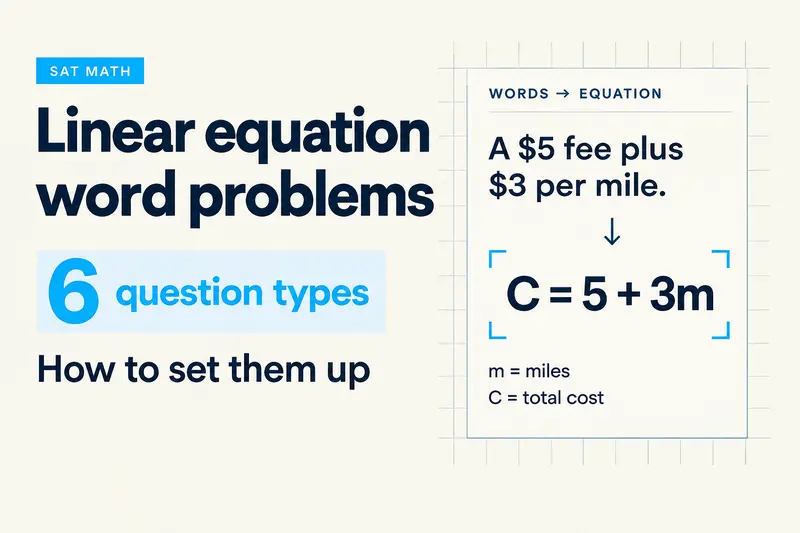
Quick answer: Almost every SAT linear equation word problem reduces to one of six set-ups: a fixed fee plus a rate, two items adding to a known total, rate times time, comparison language like "more than" and "fewer than", two options that cost the same at some point, and a percent change applied to a base amount. Most of the points you lose here come from translating the words into the wrong equation, and once you can name the pattern on sight the algebra takes care of itself.
If you miss a linear equation word problem on the SAT, the odds are good that your algebra was fine. What went wrong earlier is the translation, because the equation you wrote down did not describe the situation in the passage. By the time you are solving for x you are already solving the wrong problem, and nothing later in your work can rescue it.
That is the part worth studying. Practicing more algebra will help you a little, and practicing the act of turning words into the right equation will help you far more, because the SAT reuses the same small handful of set-ups on almost every form.
These set-ups all live inside the SAT's Algebra content domain, and once you can recognize them the word problem stops feeling like a reading comprehension test wearing a math costume. Below you will find the six most common types. Each one gets a worked example and then a trap version, which is a lightly reworded variant built to catch students who assumed they had already mastered the pattern.
On this page
Fixed fee plus a rate
Two items, one total
Rate times time
Comparison language
Equal-value systems (break-even problems)
Percent change on a base amount
Where this fits into a study plan
FAQ
Problem No. | Type | How to spot it | Equation Shape |
|---|---|---|---|
1 | Fixed fee plus rate | A flat charge alongside a per-unit charge | y = mx + b |
2 | Two items, one total | Two quantities with a count total and a value total | System of 2 equations |
3 | Rate times time | Something accumulates steadily over time | rate x time (+ start) |
4 | Comparison language | "More than", "fewer than", "times as many as" | Direct translation, watch the sign |
5 | Equal-value systems | Two options compared, asked when they match | Set two expressions equal |
6 | Percent change on a base | A markup, discount, tax or fee on a starting amount | (1 ± rate) x base ± flat amount |
1. Fixed fee plus a rate
The pattern: something starts at a flat amount and then climbs (or falls) steadily from there. This is y = mx + b in disguise, where the fixed fee is your b and the rate is your m.
Worked example: A moving company charges a flat $75 fee plus $40 per hour. Write an equation for the total cost, C, of a job that takes h hours.
Set-up: the flat fee is the piece that never changes no matter how long the job runs, so it is your y-intercept, and the hourly charge is what multiplies the variable.
C = 40h + 75
Trap version: A moving company charges a flat fee plus $40 per hour. A 3-hour job costs $195. What is the flat fee?
This time nobody hands you the equation. You have to build it from one data point and then solve for the constant instead of the total, so you write 195 = 40(3) + b and find that the flat fee is $75. If you memorized "flat fee plus rate" as a shape without understanding why the fee sits in the intercept, this is where you end up plugging numbers into the wrong slot.
2. Two items, one total
The pattern: two different quantities combine into a known total, and there is usually a second total attached to value or cost. This is the classic system of two equations.
Worked example: A movie theater sells adult tickets for $12 and child tickets for $8. One showing sold 150 tickets for a total of $1,560. How many adult tickets were sold?
Set-up: write one equation for the count and one for the value.
a + c = 150
12a + 8c = 1,560
Solve the system, where substitution works cleanly, and you get a = 90.
Trap version: the numbers stay the same, but now the question asks for child tickets, or it gives you the revenue first and the ticket count second. If you skim for "150" and "1,560" and start writing, you will pair them with the wrong equations. What saves you here is deciding which quantity is being counted and which is being valued before your pencil touches the page.
3. Rate times time
The pattern: distance, work or output equals a rate multiplied by time, sometimes with two rates running alongside each other or against each other.
Worked example: A printer prints 24 pages per minute. It has already printed 60 pages when a second printer starts up at 30 pages per minute. After how many minutes will the two printers have printed the same total number of pages?
Set-up: write two expressions for "pages printed" and set them equal.
24t + 60 = 30t
Solve and you get t = 10.
Trap version: the second printer has a head start of its own, say 45 pages, so the equation becomes 24t + 60 = 30t + 45. If you solved the first version quickly, it is easy to carry the assumption that one side starts at zero into a question where that is no longer true.
4. Comparison language
The pattern: the problem describes one quantity in terms of another using comparison words such as "5 more than", "3 times as many as" or "half of". These translate straight into an equation, and the direction of the translation is exactly where the points leak out.
Worked example: Sam has 5 more than twice as many books as Priya. Together they have 35 books. How many books does Priya have?
Set-up: let Priya be p. "Twice as many as Priya, plus 5" gives you Sam = 2p + 5.
p + (2p + 5) = 35, so p = 10.
Trap version: "Sam has 5 fewer than twice as many books as Priya", where one word flips the sign and turns 2p + 5 into 2p − 5. This is the most common way students give away points on comparison problems, because they see the structure clearly and then mistranslate "more than" against "fewer than", or attach the multiplier to the wrong quantity.
5. Equal-value systems (break-even problems)
The pattern: two competing options, usually two phone plans, two gym memberships or two pricing structures, and the question asks when they cost the same or which one is cheaper past a certain point.
Worked example: Plan A costs $30 per month with no sign-up fee. Plan B costs $20 per month plus a $60 sign-up fee. After how many months do the two plans cost the same?
Set-up: set the two cost expressions equal to each other.
30m = 20m + 60, so m = 6.
Trap version: the question asks instead for what values of m Plan A is cheaper than Plan B, which turns the same set-up into an inequality. If you have only ever practiced finding the break-even point, you will stop at m = 6 when the question wanted the range on one side of it.
6. Percent change on a base amount
The pattern: a starting amount goes up or down by a percentage, often with a flat amount tacked on, such as a discount plus a fee or a markup plus a tax.
Worked example: A jacket's price is marked up 20% from its wholesale cost, and then a flat $5 shipping fee is added. If the final price is $65, what was the wholesale cost, w?
Set-up: a 20% markup means you multiply by 1.20, rather than adding 0.20 somewhere at the end.
1.20w + 5 = 65, so w = 50.
Trap version: the fee lands before the markup instead of after it, which gives you 1.20(w + 5) = 65 and changes both the structure of the equation and the answer. Words like "then", "after" and "before" are doing real mathematical work in these problems, so slow down for half a second when you hit one.
Where this fits into a study plan
None of these six types ask anything advanced of you. They ask you to notice which pattern is in front of you before you start solving, and that is the kind of mistake you can repeat for weeks without catching it, because the arithmetic still feels right even when the equation was wrong from the very first line.
If you want a wider bank of algebra reps across all the linear equation and system question types the SAT tests, our SAT algebra practice questions post covers that ground. For the bigger picture of how Algebra sits alongside the other math domains, take a look at our digital SAT Math section guide. And if you would rather work through official items straight from the source, the College Board's Student Question Bank has real retired digital SAT questions you can filter by domain.
Studying for the SAT right now? Hue Prep flags which of these set-up patterns you keep missing and then gives you targeted practice on that pattern, instead of a random mix of algebra questions you already have down.
FAQs
What are the most common types of SAT linear equation word problems?
The six you will see most often are a fixed fee plus a rate, two items that combine into a known total, rate multiplied by time, comparison language such as "more than" or "times as many as", two options compared for an equal value (the break-even question), and a percent change applied to a base amount.
Why do students miss linear equation word problems if they are good at algebra?
Usually because the equation they wrote does not match the situation described, which makes it a translation error rather than a calculation error. The SAT reuses a small number of set-ups and then reworded trap versions of them, and those variants are built to catch students who recognized the shape of a problem without catching the wording that flips it.
Are digital SAT linear equations different from old paper SAT?
The underlying algebra is the same. The digital SAT adapts by module and its questions tend to be shorter and more direct, so the set-up patterns in this guide apply to both formats. The College Board's Digital SAT Suite overview has the full format details.
How many linear equation and system questions are on the SAT?
Algebra, which covers linear equations, systems and inequalities, is one of the four tested math domains and accounts for roughly a third of the Math section. Exact counts move around by test form, so check the College Board's official test specifications for the current breakdown.
What is the fastest way to get better at these specific word problems?
Work out which of the six set-ups you keep missing and drill that one pattern on its own before you go back to mixed general algebra practice. Mixed practice makes it much harder to see the pattern you keep mistranslating.
Sources
College Board, Digital SAT Suite Assessments Overview: official specification for the Math section's tested domains, including Algebra.
College Board, Student Question Bank: official retired digital SAT questions, filterable by domain and skill.
Blog
Recent Articles
AI automation insights to help your business move faster and smarter.